
Lynn County Court Records After Arrest
After a Lynn County jail arrest, the first public clue may be a custody record, a warrant, or a short charge line from the jail side. That is not the same thing as the court case. The court record starts to take shape when a prosecutor files or presents charges, the clerk opens a case, and the court sets hearings, bond conditions, deadlines, or disposition entries. The arrest explains why a person was booked. The court records explain what the government chose to file and how the case is moving.
For custody and booking details, start with Lynn County jail inmate records. For booking photos or mugshot questions, use the separate Lynn County jail mugshots resource. Court records after a jail arrest should be read as case records: complaint, information, indictment, docket entries, bond orders, charge status, plea, trial result, dismissal, or sentence. Those records may lag behind the booking event because a new arrest has to move through magistrate warnings and prosecutor review before a filed charge appears.
Lynn County Arrest to Court Route
The charge level controls the next stop. Felonies in Lynn County route through the 106th District Court, the District Clerk, and the District Attorney. The District Court page lists Judge Reed Filley at P.O. Box 1268, Lamesa, Texas 79331-1268, phone 806-872-3740. The District Clerk page lists Courtney Odom at P.O. Box 939 and 1501 South 1st Street in Tahoka, phone 806-561-4274. The District Attorney page lists Philip Mack Furlow at P.O. Box 1124, Lamesa, phone 806-872-2259.
Lower-level matters may move through different offices. The County Attorney page lists Rebekah Filley at 1501 South 1st Street and P.O. Box 848 in Tahoka, phone 806-561-5286, with Liz Tew listed for victim assistance. The County Clerk page lists Karen Rendon at 1501 South 1st Street and P.O. Box 937, phone 806-561-4750. The Justice Court page lists JP Precinct 1 Judge Christie Olivan at 905 Lockwood, phone 806-561-4337, and JP Precinct 4 Judge Sharla Edwards at 1015 South Loop 76 in O'Donnell, phone 806-428-3711, with Precinct 4 hours Tuesday and Wednesday 8 a.m. to 4 p.m. and Thursday 8 a.m. to noon.
Because Lynn County has no official countywide court-charge shortcut for every case type, a good search starts with the likely court level, then moves to the clerk that keeps that file. A felony arrest and a JP citation can both follow an arrest, but they will not create the same kind of record.
Search Lynn County Court Records
The statewide re:SearchTX court-record portal is the main online channel named in the research for participating Texas court records. It may require an account, agreement to terms, or court participation before a user can see a record. Static inspection did not capture exact field labels, so search instructions should follow the fields shown live in the portal instead of assuming a fixed Lynn County form.
The re:SearchTX portal is shown in the captured source image for Texas court-record access.
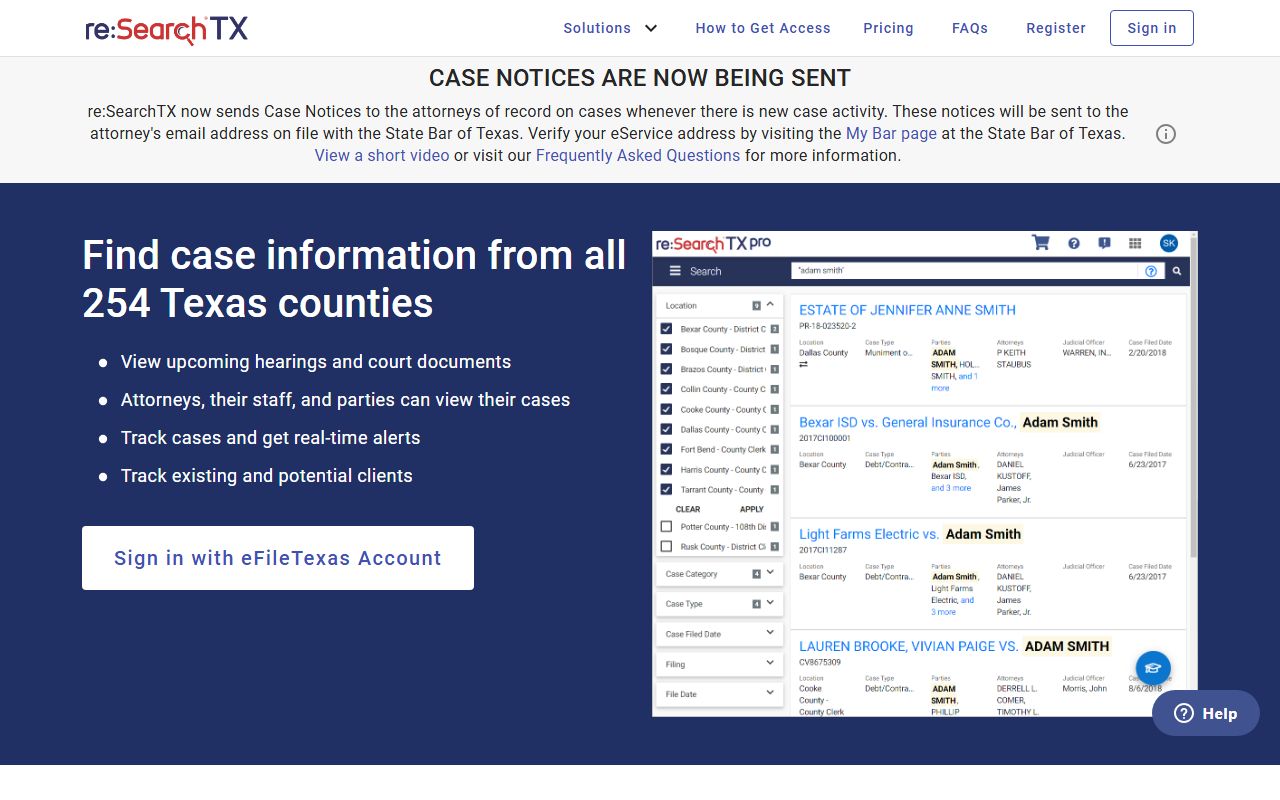
Use the portal as one court-record channel, then confirm Lynn County case copies, settings, and filing status with the correct clerk when the online result is missing, incomplete, restricted, or unclear.
| Search channel | Access facts | Best use after arrest |
|---|---|---|
| re:SearchTX | Statewide portal for participating Texas courts; may require account or terms. | Check for public case records by the fields displayed by the portal. |
| District Clerk | Lynn County district-court file office. | Felony case numbers, settings, file copies, and district filings. |
| County Clerk | Official public records and some county-level records. | County-level record requests and clerk-held public documents. |
| Justice Court | JP-level citations, fine matters, and low-level court issues. | Failure-to-appear, citation, and JP case questions. |
Lynn County Charging Records
A court record after a jail arrest is built around a charging document. An officer's arrest reason or booking line can be broad, short, or preliminary. The filed charge is more formal. It may be a complaint, an information, or an indictment, depending on the offense level and court path. The prosecutor can also reject a charge, reduce it, amend it, or present it to a grand jury.
| Document | Who uses it | What it means | Lynn County route |
|---|---|---|---|
| Complaint | Officer or prosecutor | A sworn accusation that can begin a criminal process. | Often tied to lower-level or early-stage matters. |
| Information | Prosecutor | A formal prosecutor-filed charge used without a grand-jury indictment. | Common in many misdemeanor prosecutions. |
| Indictment | Grand jury | A formal felony charging instrument returned after grand-jury review. | Felony cases route through District Court, District Clerk, and District Attorney. |
These terms matter because the filed document controls the case record. A person can be booked on one allegation, then face a different filed charge after review. That difference is not a clerical error by itself. It reflects the gap between arrest, booking, prosecutor screening, and court filing.
Lynn County Charge Status
Charge status tells whether the case is still open, has been formally filed, has changed, or has ended. It is not the same as custody status. A person can be out on bond with a pending charge, still in jail on a hold after one charge is dismissed, or transferred after a conviction. Read each charge line separately because a single case can include more than one count.
| Status | Plain meaning | What to check |
|---|---|---|
| Pending | The case or charge is unresolved. | Next setting, bond conditions, and whether all counts are pending. |
| Filed | The prosecutor has started the court charge. | Charging document, case number, court, and clerk file. |
| Amended or reduced | The prosecutor changed the charge or level. | Original booking allegation and current filed charge. |
| Dismissed | The charge was dropped by the court or prosecutor. | Whether other charges or holds remain active. |
| Disposed | The case reached a result. | Plea, verdict, dismissal, sentence, or other final entry. |
| Conviction | There has been a guilt finding by plea or judgment. | Judgment, sentence, probation, fine, or custody transfer. |
Bond After Lynn County Arrest
Texas bond law is separate from the court-record search, but bond orders often appear in court records after an arrest. The early appearance is governed by Texas Code of Criminal Procedure Article 15.17, which covers magistrate warnings after arrest. Bail and release issues are governed by Texas Code of Criminal Procedure Chapter 17. Lynn County did not publish a local online jail bond-payment instruction page in the research, so families should verify amount, bond type, and accepted posting method with the Sheriff's Office before going to the jail.
| Bond type | How it works | Lynn County caution |
|---|---|---|
| Cash bond | The full cash amount is posted with the proper authority. | No official local online cash-bond instructions were found. |
| Surety bond | A licensed bail bond company posts bond for a fee. | Confirm acceptance and exact case details before payment. |
| Personal or PR bond | Release is based on a promise to appear, sometimes with conditions. | A judge or magistrate sets it, not the jail staff. |
| Property bond | Property is pledged where allowed by law and court order. | No Lynn County property-bond instructions were located. |
| No-bond or hold | Release is blocked by court order, warrant, parole hold, federal hold, or detainer. | Ask whether a separate agency or court controls release. |
Lynn County Arrest Warrants
No official Lynn County active-warrant portal, sheriff warrant search, or most-wanted list was located in the research. Justice Court payment links are not a countywide warrant search. If a Lynn County arrest came from a warrant, the record may appear as a booking record first and a court record later, but confirming the warrant usually requires the issuing court, the sheriff, or the clerk tied to the case.
Warrant types can include an arrest warrant, a bench warrant or capias for failure to appear, another county's warrant, a parole or blue warrant, or a federal hold. Do not treat third-party warrant pages as official Lynn County records. For a possible JP-level failure to appear, contact the relevant Justice Court. For felony court records after a warrant arrest, check the District Clerk and District Attorney path.
Note: A search warrant is different from an arrest warrant because it authorizes a search, not a jail booking.
Lynn Charges vs Convictions
An arrest and a filed charge are accusations. A conviction is a court result. This distinction is crucial when reading Lynn County court records after arrest because a booking entry, filed charge, and final judgment can all show different words. A dismissed charge should not be described as a conviction. A pending charge should not be treated as proof of guilt.
| Point | Charge | Conviction |
|---|---|---|
| Stage | Accusation after arrest or prosecutor filing. | Final guilt result by plea, verdict, or judgment. |
| Proof | Based on probable cause and charging review. | Requires a plea or proof beyond a reasonable doubt. |
| Record meaning | May be pending, amended, reduced, or dismissed. | May affect sentence, probation, custody, and background records. |
| How to verify | Check the current docket and charging document. | Check judgment, sentence, and final disposition. |
Sealed or Expunged Records
Some court records after an arrest may be restricted. Juvenile records, sealed records, expunged records, certain active-investigation material, and sensitive law-enforcement details may not be public. The Texas Public Information Act supports access to government information, while Government Code Section 552.108 can protect law-enforcement or prosecutor information in qualifying matters. Section 552.108(c) still preserves access to basic information about an arrested person, an arrest, or a crime.
| Record result | Public effect | Texas source | Practical note |
|---|---|---|---|
| Sealed or nondisclosed | Hidden from many public searches, with limited access for authorized users. | Court order and Texas nondisclosure rules, when available. | Ask the clerk what can be released before assuming no case exists. |
| Expunged | Removed or treated as not existing for many public purposes. | Texas Code of Criminal Procedure Chapter 55. | Eligibility depends on the case result and statutory rules. |
| Commercial record removal | Private publishers may have duties after proper notice. | Business and Commerce Code Chapter 109. | This is not a Lynn County clerk or sheriff removal policy. |
Lynn Court Records Access Limits
Public access is strongest when the request is clear, the case is public, and the record is held by the office contacted. A sheriff booking record, District Clerk felony file, County Clerk public-record request, and Justice Court citation file are different records held by different offices. A written Texas Public Information Act request should go to the office that created or maintains the record. Clerks can provide file access and copies within their role, but they cannot give legal advice.
Background checks add another limit. Casual court lookup is not the same as a regulated consumer report. Records used for employment, housing, credit, insurance, or other covered screening must follow Fair Credit Reporting Act rules and any other law that applies to the user.
Important: Do not use unverified court, arrest, or custody information for FCRA-covered decisions.